Preeclampsia Screening in the First Trimester: Combining sFlt-1/PlGF Ratio with Advanced CLIA
1.Why early PE risk assessment matters
Pre-eclampsia (PE) is a multisystem pregnancy disorder usually recognized after 20 weeks of gestation, commonly involving hypertension plus maternal organ dysfunction and/or uteroplacental dysfunction. Because placental dysfunction can develop before clinical symptoms appear, early risk assessment can help clinicians identify women who may need closer follow-up. In the first trimester, the most evidence-based screening approach combines maternal risk factors, mean arterial pressure (MAP), placental growth factor (PlGF) and uterine artery pulsatility index (UtAPI), rather than relying on a single marker.
2. From first-trimester screening to sFlt-1/PlGF monitoring
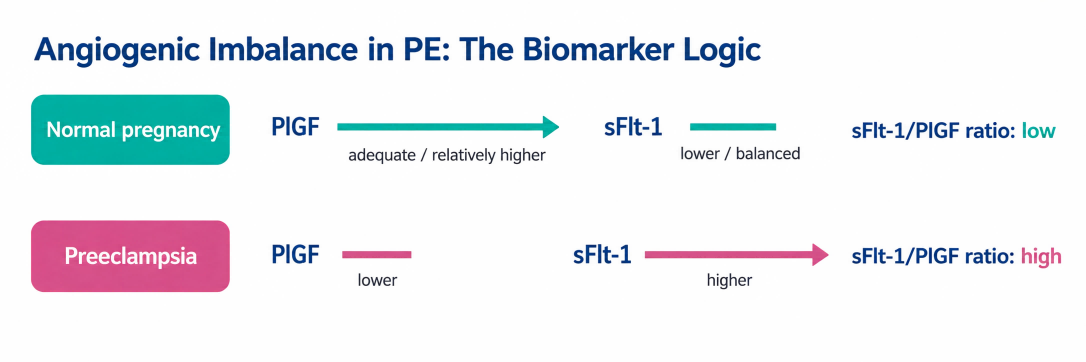
PlGF supports first-trimester risk screening because it reflects placental angiogenesis. When PE is suspected later in pregnancy, the angiogenic balance becomes more clinically informative: sFlt-1 tends to increase, PlGF tends to decrease, and the sFlt-1/PlGF ratio may help rule in or rule out short-term PE risk when used with blood pressure, urine protein, symptoms, organ-function tests and fetal assessment. A ratio <=38 is widely used as a low short-term risk threshold in suspected PE assessment, while elevated ratios should prompt closer clinical review according to local protocols.
3. Poclight C5000: compact CLIA support for pregnancy-care testing
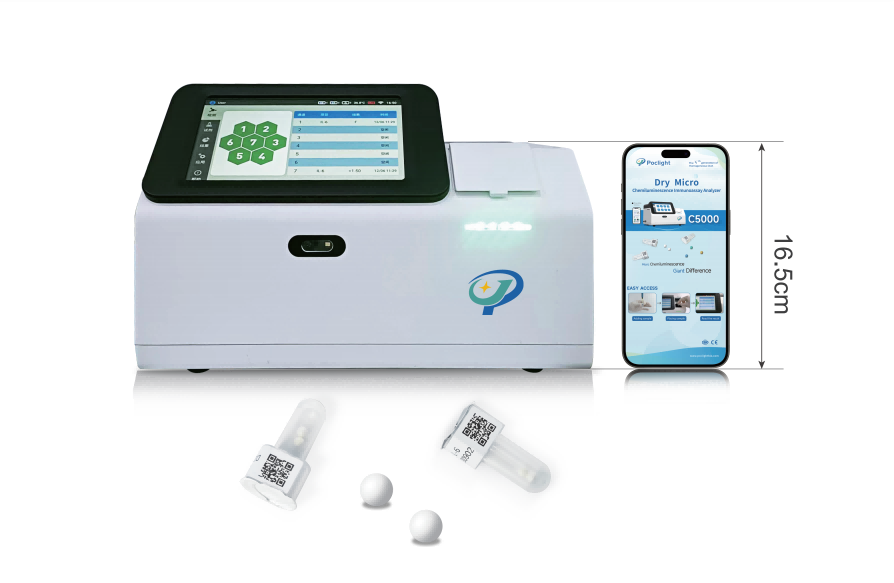
Poclight sFlt-1 and PlGF assays are designed for quantitative testing in serum or plasma on the C5000 homogeneous CLIA platform. The two assays are used together to calculate the sFlt-1/PlGF ratio as an aid in PE assessment in conjunction with clinical information. C5000 is positioned for fast, flexible testing with seven independent detection channels, compact size, room-temperature lyophilized reagents and simplified operation.
|
Assay / system |
Sample |
Sample volume |
Time |
Key information |
|
sFlt-1 |
Serum / Plasma |
100 uL |
5 min |
Measuring range 10-85000 pg/mL; LOD <=10 pg/mL |
|
PlGF |
Serum / Plasma |
100 uL |
5 min |
Measuring range 3-10000 pg/mL; LOD <=3 pg/mL |
|
sFlt-1/PlGF ratio |
Calculated from both assays |
- |
- |
Used as an aid in PE assessment with other clinical information; <=38 supports low short-term risk in suspected PE contexts |
|
C5000 platform |
Whole blood / Serum / Plasma platform capability |
- |
Time to first result 3 min |
7 detection channels; max 80 tests/hour; 325 x 231 x 213 mm; <=8.5 kg; 2-30 deg C reagent storage |
|
Key Messages • Early placental insight: PlGF helps bring placental biology into first-trimester PE risk assessment. • Dynamic follow-up: sFlt-1/PlGF ratio supports suspected PE assessment after 20 weeks when interpreted clinically. • Compact CLIA workflow: C5000 enables fast, room-temperature, multi-channel testing for pregnancy-care settings. |
|



 IPv6 network supported | XML | Sitemap | Blog | Privacy Policy
Leave A Message
Scan to wechat :


 English
 français
 русский
 español
 português
 العربية
 日本語
日本語 Türkçe
 हिंदी
हिंदी Indonesia